AI Governance
What is AI TRiSM?
AI TRiSM stands for AI Trust, Risk and Security Management. It is a framework, coined by Gartner, for managing the trust, risk and security of AI systems across their lifecycle, from the data and models underneath to the governance and oversight on top. It is a way to make sure the AI an organisation builds and uses is reliable, safe and accountable.
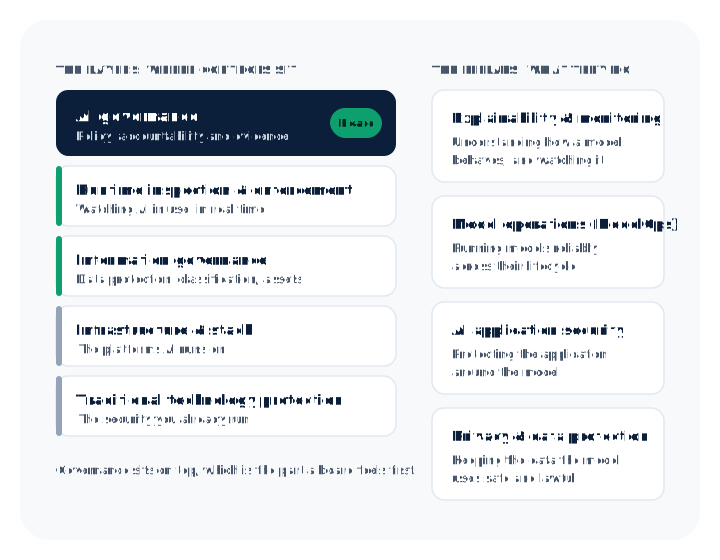
The framework
The AI TRiSM framework.
AI TRiSM is usually described in two ways, and they fit together. The first is a layered stack: traditional technology protection at the base, then the infrastructure and stack, then information governance (data protection, classification and asset management), then runtime inspection and enforcement of AI in use, and AI governance at the top.
The second is a set of pillars: explainability and model monitoring, model operations (ModelOps), AI application security, and privacy and data protection. The layers describe where controls sit; the pillars describe what they do.
Governance
AI TRiSM and AI governance: the difference.
AI governance and AI TRiSM are related but not the same. AI governance is the policy, accountability and evidence layer: who is allowed to use what, how risk is classified, and how you prove it. AI TRiSM is the wider picture that puts that governance on top of the technical controls beneath it, from data protection to runtime enforcement. Governance is one part of TRiSM, usually the part a board feels first.
Related
Standards and law
How AI TRiSM maps to the EU AI Act and ISO 42001.
AI TRiSM is a framework, not a law or a certificate, so it sits alongside the standards and regulations rather than replacing them. ISO/IEC 42001 gives you a certifiable management system for governing AI, which covers much of the governance layer. The EU AI Act is the legal obligation where you are in scope. The NIST AI Risk Management Framework offers a structure for the risk work. AI TRiSM is a useful way to organise all of it into one view; the standards are how you evidence each part.
Where to start
Start with an inventory.
The first step in AI TRiSM is an inventory, because you cannot govern, secure or assess AI you cannot see. From there the order is familiar: find where AI is used, classify the risk of each use, put controls and oversight in place, and keep the evidence. Most organisations still lack that first inventory, which makes it the cheapest, highest-value place to begin.
See our AI governance workFor the board
What it means for a UK board.
For a UK organisation, AI TRiSM is a helpful lens, not an obligation in itself. What bites is narrower: the EU AI Act if you serve EU users, ISO 42001 as a procurement signal, and the FCA’s existing expectations in financial services. AI TRiSM is the vocabulary that ties those together, and a reasonable checklist for making sure nothing is missed.
FAQ
AI TRiSM, in brief
Short, straight answers to what boards and buyers ask most. Still need a steer on your own situation?
Book a callWhat is AI TRiSM?
AI TRiSM stands for AI Trust, Risk and Security Management. It is Gartner's framework for managing the trust, risk and security of AI across its lifecycle, covering the data and models, the controls that protect them, and the governance that holds it accountable.What are the four pillars of AI TRiSM?
Explainability and model monitoring, model operations (ModelOps), AI application security, and privacy and data protection. Together they cover understanding how a model behaves, running it reliably, protecting the application around it, and keeping data safe.Is AI TRiSM the same as AI governance?
No. AI governance is the policy and accountability layer: rules, risk classification and evidence. AI TRiSM is broader and includes governance alongside the technical controls beneath it. Governance is one part of TRiSM.Do UK organisations need AI TRiSM?
AI TRiSM is a framework, not a legal requirement, so no organisation has to adopt it by name. It is a useful way to organise the work. What is actually required is narrower: the EU AI Act where you are in scope, and the expectations of your own regulators and customers.How does AI TRiSM relate to ISO 42001?
ISO 42001 is a certifiable standard for an AI management system and covers much of the governance layer that AI TRiSM describes. AI TRiSM is the wider framework; ISO 42001 is one of the ways you evidence part of it.
Last reviewed: By the Threat Protect editorial team
Keep reading
Turn the framework into a plan.
If you want help turning AI TRiSM into something your board can act on, book a call and we will map a practical path.
Book a call