AI Governance
Control your AI spend and the value you get from it
AI is being bought on company cards and bundled into renewals across your business, often with no single owner and no view of what it costs or returns. We give you one picture of the AI you are paying for, what it is used for, and where the spend and the risk overlap.
Definition
What is AI spend management?
AI spend management is getting a single, owned view of the AI tools and subscriptions across your business: what you pay, who uses them, what for, and which ones duplicate or expose you. It turns scattered, card-bought AI into something you can budget, govern and reduce.
It is narrower than cloud cost management and tied to risk, because the same tools that cost money also touch your data. One inventory answers both the finance question and the security question.
Where it hides
Where AI spend hides.
AI is rarely bought through one front door. It arrives on expenses, inside renewals and through free trials that quietly became paid, so no single person has the full picture.
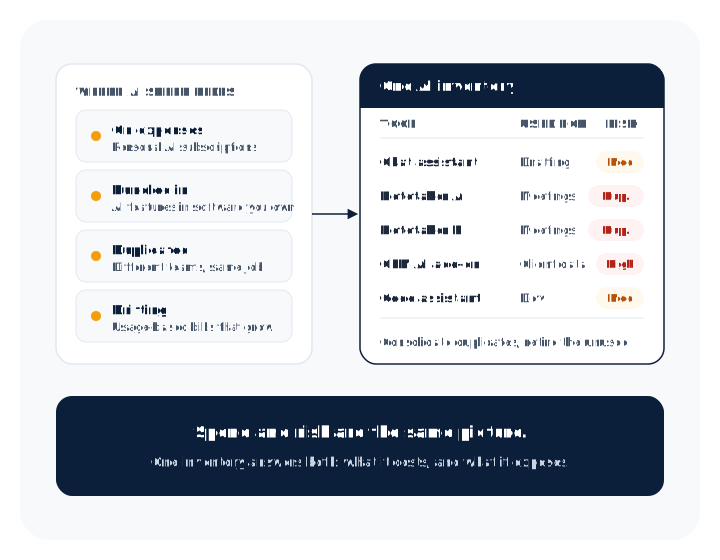
- Personal AI subscriptions claimed on expenses.
- AI features you are already paying for, bundled inside software you own.
- Duplicate tools bought by different teams for the same job.
- Usage-based bills that drift upward as adoption grows.
- Free tiers that moved to paid without anyone deciding to.
What we do
What we do.
1.Inventory
Build a single list of the AI tools and spend across the business, including the features bundled into software you already buy.
2.Map
Map each tool to what it is used for, who owns it, and the risk it carries, so cost and exposure sit in one view.
3.Consolidate
Retire what is unused, consolidate duplicates where several teams bought the same thing, and right-size the rest.
4.Govern
Set a simple approval and review process so new AI spend stays visible, rather than rebuilding the same sprawl in six months.
Related
Spend and risk
Spend and risk are the same picture.
The shadow AI you are paying for is also the shadow AI that may be leaking your data. One inventory answers both questions: what it costs and what it exposes.
That is why we run spend alongside governance rather than as a separate finance exercise. The work to find what you are paying for is the same work that finds where your data is going, so doing them together means one piece of work answers two questions the board cares about.
Not FinOps
How this differs from FinOps.
FinOps is a broad discipline for managing cloud infrastructure cost, built around engineering teams and cloud bills. AI spend management is narrower and tied to risk: it covers AI tools, licences and subscriptions, including the ones bought outside IT, and it links what you spend to what that tool can access and expose.
If you already run a FinOps practice, this sits alongside it rather than competing with it. The difference that matters is the risk lens: an AI tool is not just a line of spend, it is a route your data can take out of the business.
Where it fits
Where AI spend management fits.
Spend control is one part of governing your own AI. The inventory it produces is the same inventory that underpins an AI policy, a risk assessment and ISO 42001 readiness, so the work compounds rather than being thrown away.
FAQ
Questions buyers actually ask
What is AI spend management?
It is getting a single, owned view of the AI tools and subscriptions across your business: what you pay, who uses them, what for, and which ones duplicate or expose you. It turns scattered, card-bought AI into something you can budget, govern and reduce.How is this different from FinOps?
FinOps is a broad discipline for managing cloud infrastructure cost. AI spend management is narrower and tied to risk: it covers AI tools, licences and subscriptions, including the ones bought outside IT, and it links what you spend to what that tool can access and expose.Why run spend and governance together?
Because they look at the same thing from two angles. The inventory that tells you what AI you are paying for is the same inventory that tells you where your data is going. Doing them together means one piece of work answers both the finance and the security question.How do we find AI spend that is bought outside IT?
Through a combination of expense and card data, a review of the software you already own for bundled AI features, and short conversations with teams about what they use. Most organisations are surprised by how much turns up, because so much of it was bought to solve an immediate problem rather than through procurement.What is shadow AI, in spend terms?
Shadow AI is any AI tool used without oversight, and in spend terms it is the subscriptions and features nobody has on a central list. It matters twice over: it is money you are not tracking, and it is a route your data can take out of the business without a record of where it went.
See what AI you are really paying for.
Tell us where AI is turning up in your business. We will build one view of the spend and the risk, and show you what to consolidate first.
Book a call